Services
What we do
Everything below is work we have already done on industrial parts, and each section says what came out of it. If your problem sits between two of them, it is still the right conversation to have.
Python bindings for C and C++ SDKs
More of the people who use a C or C++ SDK now write Python, to automate CAD workflows, feed AI pipelines and run web services. We write the Python API for it: bindings in pybind11, nanobind or Cython, type stubs, tests, documentation and wheels for every platform, in your repository and under your ownership.
Proof. A translator on the Datakit SDK in C++17 with Python bindings, shipped as native wheels for Linux and Windows with OpenCASCADE linked in. A NURBS module compiled with Cython, 100× faster than the same evaluation in pure Python. A pure-Python kernel moved onto OpenCASCADE while keeping its Python API.
Feature recognition and shape analysis
Most applications around 3D depend on knowing what a part is made of. DFM checks, CNC quoting, sheet-metal unfolding, defeaturing before simulation, similarity search and CAD reconstruction all start from the same step: finding the features on the B-rep. We read them from the face adjacency graph of the part and the geometry of each face.
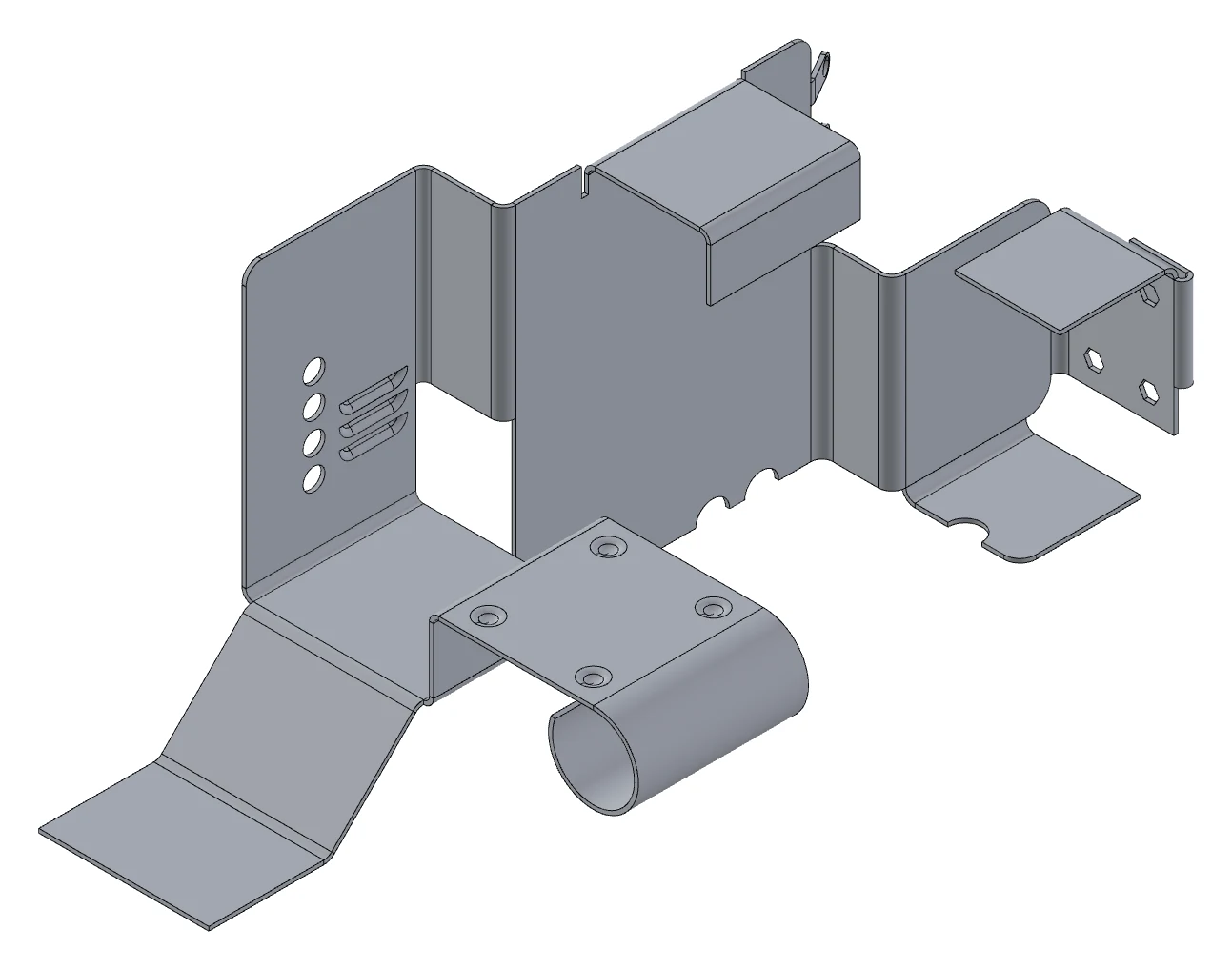
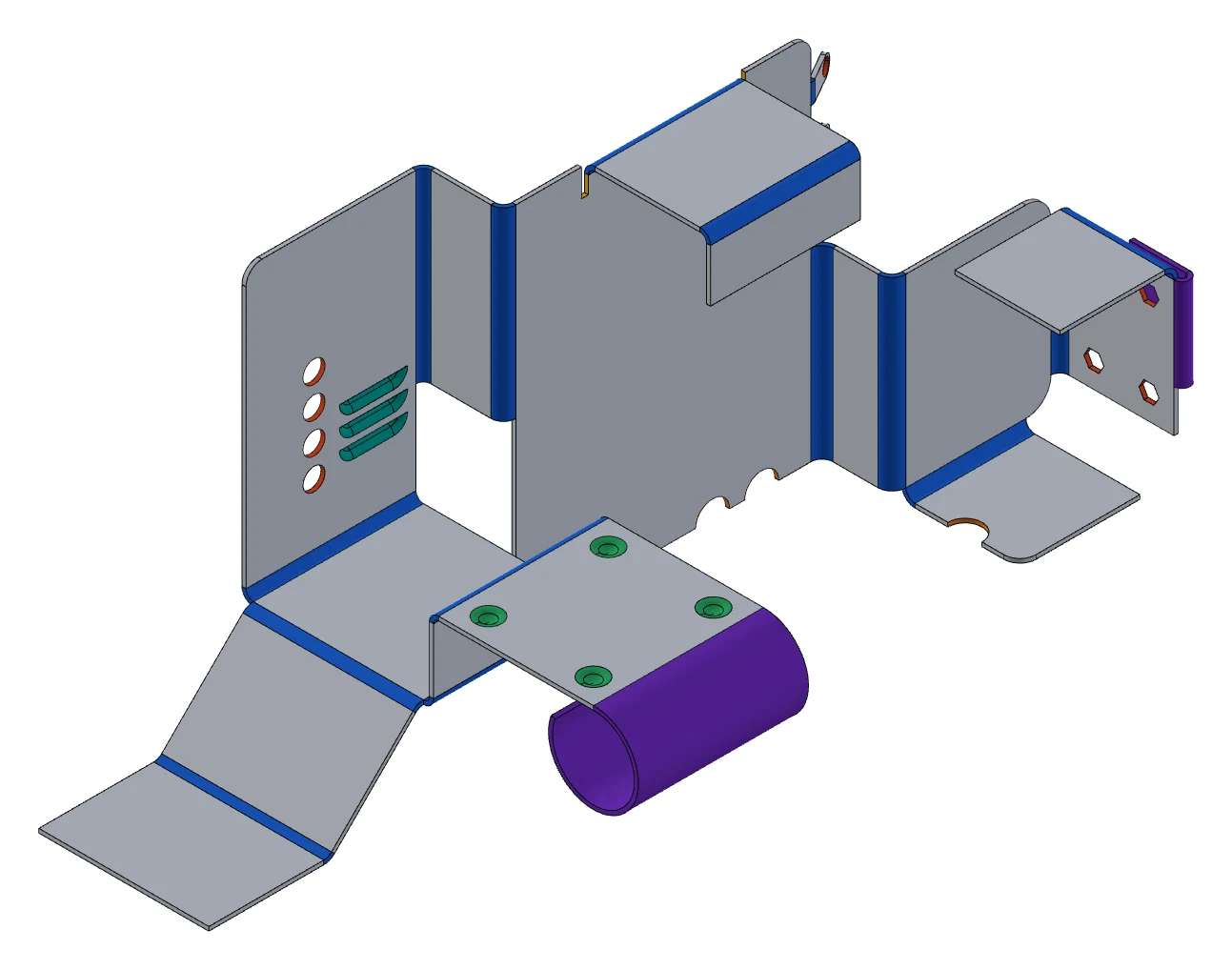
- Bend
- Hem, roll
- Dimple
- Louvre
- Hole
- Notch
- Bend relief
- Holes, ribs, walls, blends, chamfers, cavities, extrusions and revolutions
- Sheet-metal features, repeated patterns, similarity signatures
- Defeaturing: blend suppression, cavity and hole filling
- Reconstruction of a solid into an editable parametric model, as code
- Design-rule checking on production parts
- 882 tests on the recognition module at 89% coverage
- 2.1× faster rib extraction on an A-pillar part, all 25 reference ribs unchanged
- 3 → 0 invalid results from blend suppression while removed blend chains went from 199 to 207
- 5–11× faster test suite on the same recognition module
Talk to us about feature recognition
CAD data exchange and interoperability
Getting data in and out of a CAD system is difficult. There are dozens of formats and each one keeps changing. A vendor can license a translator such as HOOPS Exchange or Datakit, or build its own data exchange library. We have built both kinds for clients, so we can tell you what each choice costs.
- A STEP reader and writer built from scratch: assemblies, units and the tolerances declared in the file
- A translator on the Datakit SDK, in C++17 with Python bindings: CATIA V5 parts, products and drawings, SolidWorks, NX, 3DXML
- Construction tree, metadata and physical materials carried across with the geometry
- Output as OpenCASCADE B-rep, meshes with topology, and 2D drawing data
- Native wheels for Linux and Windows, with OpenCASCADE linked in
- Migration of a pure-Python kernel onto OpenCASCADE, keeping its Pythonic API, and JSON serialisation of its geometry and topology for web platforms
- 27× faster STEP structure reading on an industrial door part
- 2.8× faster point inversion on a door part with about 2,000 BSpline faces
- +54 metadata entries recovered on a SolidWorks part
Also. A NURBS translation defect traced and fixed with the SDK vendor. Files from many CAD exporters in automotive, aerospace and energy.
Talk to us about data exchange
Technical drawing analysis
Manufacturing still reads parts from drawings. Automatic drawing generation and checking need the drawing as structured data: its views, what each dimension measures, what the title block says. We built that data model and the analysis on top of it.
- One model for sheets, views, layers and annotations, read from CATIA V5 and NX drafting
- Views, sections, details and auxiliary views with their titles, in reading order
- Dimensions linked to the geometry they measure: linear, radius, diameter, angular
- GD&T frames, datums, roughness, welding symbols and balloons
- Title blocks, tables and bills of materials rebuilt from lines and text
- Drawing rule checks, with pass and fail highlighted on the sheet
Proof. A production Python package for 2D technical drawings, with rendering modules, unit tests and documentation, used on industrial drawings in several languages.
Talk to us about drawing analysis
Geometry kernel and algorithms
We write the parts of a kernel that the rest of the software stands on: curves and surfaces, their parametrisation, and the operations between them. We have built all of these from the first line, in a B-rep kernel the two of us wrote most of.
- NURBS and BSpline curves and surfaces: evaluation, derivatives, knot operations, fitting
- Point inversion and 3D to parametric mapping of curves onto every surface type
- Curve and surface intersections: planes, cylinders, cones, spheres, tori and BSplines
- Booleans, sewing and shell repair on real, imperfect geometry
- Triangulation and meshing of trimmed faces
- Minimum distance, collision and clearance between shells
- 63,000 lines in the B-rep kernel two thirds of them written by the two of us
- 5,200+ commits on the kernel
- 860+ unit tests on the kernel
- 52–60% less STEP import time a NURBS module built from scratch replacing a third-party library, on three industrial files, with no regression
Performance engineering of geometry code
Geometry code is usually correct long before it is fast enough. We profile it on the parts that hurt, find the few functions that take the time, and rewrite them: compiled with Cython or C++, vectorised with NumPy and SciPy, and lighter on memory.
- Profiling of import, meshing and modelling pipelines on production files
- Compiled extensions in Cython and C++, bound to Python with pybind11
- Vectorised numerics, including FFT-based collision checks
- Memory reduction on large assemblies
- ~1000× faster triangulation of complex BSpline faces meshing on industrial parts
- ~150× faster minimum distance between two shells compared with the first method delivered
- 43× faster surface fitting on a 528-face door part
- −61% memory held by shells on a 245 MB STEP file
Also. NURBS evaluation 100× faster than the same code in pure Python, and STEP structure reading 27× faster.
Stack
- Languages
- Python, Cython, C++, Rust, JavaScript
- Numerics
- NumPy, SciPy, FFT, graph algorithms
- Kernels
- A B-rep kernel built from scratch, OpenCASCADE (OCCT, OCP), build123d
- Bindings
- pybind11, nanobind, Cython extension types, type stubs, compiled wheels
- Formats
- STEP, STL, CATIA V5, SolidWorks, NX, 3DXML, JSON
- Exchange SDKs
- Datakit, OpenCASCADE data exchange
- Quality
- pytest, coverage gates in CI, benchmarks on public CAD datasets (ABC, Fusion 360 Gallery)
How we work together
You work directly with the two of us, Gabriel Jesus and Wirajan Da Silva, from the first conversation onwards. You keep the intellectual property and the code we write. If your data is confidential, say so and we will sort out an agreement before you share anything.
- 1We talk about your needs What you are building, where it is stuck, and the constraints you work under. We ask questions and tell you how we would approach it.
- 2Proof of concept, a few weeks We choose the scope together and prove the approach on your own files or code, at a small cost to you.
- 3Review We go through the result with you, adjust it, and agree the full scope and the technical choices.
- 4Project, then support if you want it The full work, with tests, CI and documentation. After that, updates and changes alongside your team.